Minimum-wage Expert to Share How to Fix the U.S. Labor Market
The author of “The Wage Standard” will join a panel discussion moderated by a New York Times economics reporter.
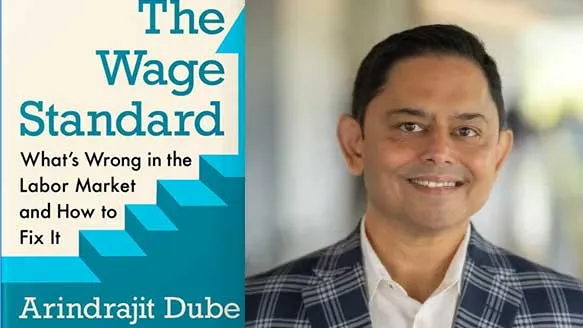
The Center for Political Economy will host a May Day talk with an author and academic whose recipe for fixing the labor market is garnering much attention since his book – “The Wage Standard: What’s Wrong in the Labor Market and How to Fix it” – was published last month.
What’s Wrong in the Labor Market and How to Fix It (Friday, May 1)
Arindrajit Dube is the Provost Professor of Economics at the University of Massachusetts at Amherst, a research associate at the National Bureau of Economic Research, and a research fellow at the IZA Institute of Labor Economics in Germany. He is also in great demand from media, having been profiled in The New Yorker (“An Economist’s Quest to Solve America’s Wage Problem”) and Publisher’s Weekly (“We’ve Created Two Americas: PW Talks with Arindrajit Dube” ).
He penned an essay for Time magazine (“America’s Cost-of-Living Crisis Is Really a Pay Crisis”), and the Big Think published an excerpt from his book (“Why don’t Walmart workers walk away from low pay? Monopsony”).
Dube told Center director David Caughlin that his May 1 talk will include a broad look at U.S. labor market with some hopeful observations.
“Drawing on two decades of research on wages, employer power, and policy, I'll paint a picture of what went wrong in the American labor market, where pay growth has been halting for most. But I'll also show how we can do better. And most encouragingly, point to early signs that we may already have started to.”
Dube will be joined by two Columbia professors for the discussion on what this means for the future of work and American democracy:
- Suresh Naidu, professor of International and Public Affairs and the Jack Wang and Echo Ren Professor of Economics
- Alex Hertel-Fernandez, the Herbert Lehman Professor of International and Public Affairs and founder of the American Democracy Initiative at Institute of Global Politics in Columbia's School of International and Public Affairs
Talmon Smith, an economics reporter for The New York Times, is scheduled to serve as moderator for the discussion.
As Dube said in the New Yorker profile, “I aim to show you why — and more importantly how — we can change the labor market to work better for us all.”
Dube acknowledged to the magazine that he isn’t saying he knows exactly what will happen, “But what I am proposing is a set of tools that can help us adapt to whatever the future crises are.”
In his essay in Time, Dube wrote about wage stagnation for U.S. workers, particularly those at the lower end of the pay scale.
“If we're serious about making life affordable for working families, we also need to talk about the other side of the ledger: paychecks. And here's the truth: over the past 45 years, wage growth for most Americans has been halting at best, often failing to keep up with the country’s overall economic gains.”
Dube writes that 20 states do not have a state minimum wage, effectively leaving half the country with no binding minimum wage. Getting those states to establish their own minimum wages would be a big step forward, he wrote.
“The evidence is clear. When minimum wage increases have appeared on state ballots, they have won nearly every time, in red, blue, and purple states alike. And in states that have raised their floors, workers have seen pay rise without the job losses often predicted by critics. Instead, companies see turnover fall and productivity rise as these jobs are made better.”